
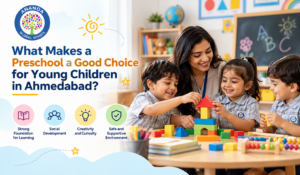
The early years of childhood are a crucial period for developing communication, curiosity, emotional awareness, and independence. A positive preschool experience gives children opportunities to explore their surroundings, build relationships, and become comfortable with structured learning. For parents evaluating a Preschool in Jodhpur Ahmedabad, understanding the role of early education can make the decision more meaningful. Ananda Global School recognises the importance of creating learning experiences that support children’s development while helping them gradually prepare for the expectations of formal schooling.
1. Building Essential Skills Through Everyday Experiences
Preschool learning extends beyond recognising letters and numbers. Young children develop foundational abilities through conversations, imaginative play, movement, storytelling, and interactions with others. These experiences help them understand their environment and become active participants in learning.
For example, sorting coloured objects introduces early mathematical thinking, while listening to a story develops attention, vocabulary, and comprehension. Group activities also teach children to take turns, share materials, and communicate their needs.
A balanced early learning environment should encourage:
- Language development: Listening to stories, expressing ideas, and learning new words.
- Early numeracy: Recognising patterns, comparing quantities, and identifying shapes.
- Fine motor coordination: Drawing, colouring, building, and handling simple learning materials.
- Social awareness: Cooperating with peers and understanding different feelings.
- Independent thinking: Making choices, solving simple problems, and exploring possibilities.
These skills develop at different rates. Children benefit most when activities are appropriate for their age and provide room for individual progress.
2. Choosing an Environment That Encourages Curiosity
When families search for the Best Preschool In Ahmedabad, they should look beyond attractive classrooms or an impressive list of activities. The quality of everyday interactions between children and educators is equally important.
A supportive environment allows children to ask questions, experiment, make mistakes, and try again without fear of embarrassment. Educators can nurture curiosity by introducing activities that encourage exploration rather than expecting every child to produce identical results.
Parents should consider the following factors when evaluating a school:
- Educator interaction: Observe whether teachers listen patiently and communicate respectfully.
- Learning resources: Look for age-appropriate books, puzzles, art materials, and opportunities for movement.
- Safety and hygiene: Check supervision practices, classroom cleanliness, and secure entry procedures.
- Emotional support: Ask how teachers help children manage separation anxiety, frustration, or disagreements.
- Family communication: Understand how the school shares developmental observations and responds to parental concerns.
A visit during regular school hours can provide a more realistic picture of the learning atmosphere than a brief formal presentation.
3. Understanding the Connection Between Play and Learning
Play is an important way for young children to understand concepts that might otherwise seem abstract. During pretend play, children practise language and explore familiar roles. Building blocks introduce spatial awareness, balance, and early problem-solving, while outdoor games encourage coordination and cooperation.
Structured activities and free play serve different purposes. Teacher-guided experiences can introduce a particular concept, while child-led play gives children freedom to follow their interests and make independent decisions.
| Learning activity | Skill being developed | Example of practical learning |
| Storytelling | Language and listening | Predicting what happens next |
| Building blocks | Spatial reasoning | Creating a stable structure |
| Art and craft | Coordination and creativity | Exploring colours and textures |
| Group games | Cooperation | Following rules and taking turns |
| Nature observation | Curiosity and awareness | Comparing leaves or noticing insects |
The goal is not to turn every activity into a formal lesson. Instead, educators can recognise learning opportunities within everyday experiences and help children make connections at their own pace.
4. Preparing Children for a Smooth School Transition
A Pre School In Ahmedabad should help children gradually become comfortable with routines and responsibilities that support their next educational stage. Readiness is not determined solely by whether a child can write letters or count confidently.
Children also need opportunities to practise listening to instructions, communicating discomfort, managing belongings, and participating in group activities. These abilities make classroom transitions more manageable and support greater independence.
Helpful preparation includes:
- Establishing consistent sleep and morning routines.
- Encouraging children to put away toys and organise simple belongings.
- Reading together and discussing everyday experiences.
- Practising short separations from familiar caregivers when appropriate.
- Helping children express feelings using simple, clear language.
Progress should be judged in relation to each child’s developmental stage. Gentle encouragement and predictable routines are generally more constructive than pressure to achieve milestones prematurely.
5. Supporting Development Through Home and School Collaboration
Children benefit when their experiences at home and school complement one another. Parents do not need to recreate classroom lessons after school. Everyday conversations, shared reading, simple household tasks, and opportunities for play can reinforce important skills naturally.
Regular communication with educators can also help families understand emerging strengths and areas where a child may need additional support. If a child struggles with communication, social interaction, or particular developmental tasks, discussing observations early can help determine appropriate next steps.
Consistency matters, but flexibility is equally important. Children may respond differently to unfamiliar activities, busy environments, or changes in routine. A collaborative approach helps adults provide reassurance without overlooking individual needs.
Frequently Asked Questions
- What is the main purpose of preschool education?
It supports early language, social, emotional, physical, and cognitive development while introducing children to group learning.
- At what age can children begin preschool?
Entry age depends on the programme and applicable education guidelines. Parents should confirm eligibility directly with the school.
- Is play-based learning academically useful?
Yes. Age-appropriate play can develop vocabulary, early numeracy, reasoning, coordination, and problem-solving.
- How can parents help children adjust to preschool?
Introduce predictable routines, talk positively about school, encourage independence, and allow time for adjustment.
- What should parents ask during a school visit?
Ask about educator qualifications, safety procedures, daily routines, class sizes, learning methods, and communication with families.
Conclusion
A meaningful preschool experience combines purposeful activities, supportive relationships, safe surroundings, and opportunities for children to develop at their own pace. Families considering a Preschool in Vejalpur should evaluate how well a school’s approach supports curiosity, emotional security, independence, and early learning milestones. By looking beyond academic worksheets and focusing on the whole child, parents can make a more informed choice that lays a strong foundation for a confident and positive educational journey.
